The Child Support (Miscellaneous Amendments) Regulations 2018
PART 1GENERAL
Citation and commencement1.
(1)
These Regulations may be cited as the Child Support (Miscellaneous Amendments) Regulations 2018.
(2)
These Regulations, with the exception of regulation 3 (Part 3), come into force 14 days after these Regulations are made.
(3)
Regulation 3 (Part 3) come into force 21 days after these Regulations are made.
PART 2AMENDMENTS RELATING TO THE GROUNDS FOR VARIATION OF A MAINTENANCE CALCULATION
Amendment of the Child Support Maintenance (Calculation) Regulations 20122.
(1)
(2)
“Assets exceeding a prescribed value69A.
(1)
Where this paragraph applies, the other cases prescribed under paragraph 4(1) of Schedule 4B to the 1991 Act5 are cases where the Secretary of State is satisfied that there is an asset in which the non-resident parent has a legal or beneficial interest and the value of that interest exceeds the prescribed value.(2)
In this regulation “asset” means—
(a)
money, whether in cash or on deposit, including any money which is due to a non-resident parent where the Secretary of State is satisfied that requiring payment of the monies to the non-resident parent immediately would be reasonable;
(b)
gold, silver or platinum bullion bars or coins;
(c)
a virtual currency which is capable of being exchanged for money;
(d)
land or rights in or over land;
(e)
shares within the meaning of section 540 of the Companies Act 20066;(f)
stock and unit trusts within the meaning of section 6 of the Charging Orders Act 19797;(g)
gilt edged securities within the meaning of paragraphs 1 and 1A of Part 1 of Schedule 9 to the Taxation of Chargeable Gains Act 19928; or(h)
a chose in action which has not been enforced on the date of an application for a variation under regulation 56 and where the Secretary of State is satisfied that such enforcement would be reasonable.
(3)
In this regulation “asset” includes any asset which is subject to a trust where the beneficiary is the non-resident parent.
(4)
Paragraph (1) does not apply in the case of any asset which—
(a)
has been received by the non-resident parent as compensation for personal injury suffered by the non-resident parent;
(b)
is being used in the course of the non-resident parent’s trade or business;
(c)
the Secretary of State is satisfied could have been purchased from the gross weekly income of the non-resident parent which has been taken into account for the purposes of a maintenance calculation;
(d)
is owned jointly by, or held in the joint names of, the non-resident parent and another individual or individuals;
(e)
will need to be sold in order to meet any additional maintenance payment required as a result of a variation under paragraph 4(1) of Schedule 4B to the 1991 Act where the sale of that asset would cause hardship to a child of the non-resident parent, or would otherwise be unreasonable having taken into account all relevant circumstances; or
(f)
is a legal or beneficial interest in land where the land in question is the primary residence of the non-resident parent or any child of the non-resident parent.
(5)
The “prescribed value” is £31,250.
(6)
In the case of an asset which is subject to a mortgage or charge, the value of that asset will be its value after a deduction is made for any amount owing under the mortgage or charge.
(7)
The Secretary of State shall calculate the weekly value of an asset by applying the statutory rate of interest to the value of the asset and dividing by 52.
(8)
For the purposes of this regulation—
“statutory rate of interest” means interest at the statutory rate prescribed for a judgment debt9 or, in Scotland, the statutory rate of interest included in or payable under a decree in the Court of Sessions applicable on the date upon which the variation takes effect;“virtual currency” means a digital representation of value that is neither issued by a central bank or a public authority, and is accepted by natural or legal persons as a means of payment and can be transferred, stored or traded electronically.”.
PART 3AMENDMENTS RELATING TO DEDUCTIONS FROM JOINT AND BUSINESS ACCOUNTS
Amendment of the Child Support (Collection and Enforcement) Regulations 19923.
(1)
(2)
In regulation 25A (interpretation of this Part)—
(a)
in paragraph (1)–
(i)
““another account-holder” means an account-holder other than the liable person in a case where a regular deduction order or a lump sum deduction order is proposed or made in respect of a joint account”; and
““joint account” includes an account used by a partnership12 formed in England or Wales, of which the liable person is a partner”;
(b)
in paragraph (3)(b), after “liable person” insert “or (where the order is made in respect of a joint account) another account-holder”; and
(c)
in paragraph (4), for “or a liable person” substitute “, a liable person or another account-holder”.
(3)
“Regular deduction order in respect of a joint account25A1.
(1)
Before making a regular deduction order in respect of a joint account the Secretary of State shall serve a notice containing the information set out in paragraph (2) and the further information set out in paragraph (3) or (4) (as appropriate).
(2)
The information for each account-holder is—
(a)
that the Secretary of State is proposing to make an order in respect of the account;
(b)
the name of the liable person;
(c)
the number and sort code of the account;
(d)
that the order would be made to secure the payment of child support maintenance payable by the liable person;
(e)
the dates on which the Secretary of State is proposing to make deductions under the order;
(f)
that each account-holder has an opportunity to make representations to the Secretary of State about the matters in sub-paragraphs (a) and (e);
(g)
that the order is likely to be made in the terms set out in the notice if representations are not made; and
(h)
the period for making representations.
(3)
The further information to the liable person is—
(a)
the amounts that the Secretary of State is proposing to deduct under the order in respect of arrears of child support maintenance payable under the calculation and amounts of child support maintenance which will become payable under the calculation;
(b)
that the liable person has an opportunity to make representations to the Secretary of State about the matters in sub-paragraph (a);
(c)
that the order is likely to be made in the terms set out in the notice if representations are not made; and
(d)
the period for making representations.
(4)
The further information to another account-holder is—
(a)
the amounts that the Secretary of State is proposing to deduct under the order;
(b)
that another account-holder has an opportunity to make representations to the Secretary of State about the matters in sub-paragraph (a);
(c)
that the order is likely to be made in the terms set out in the notice if representations are not made; and
(d)
the period for making representations.
(5)
The period for making representations to the Secretary of State in respect of the matters referred to in paragraphs (2)(a), (e) and (3)(a) or (4)(a) is—
(a)
14 days, beginning with the day on which the account-holder receives the notice; or
(b)
such longer period as the Secretary of State considers reasonable in the circumstances of the case.
(6)
A regular deduction order may not be made before the period for making representations has expired and the Secretary of State has considered any representations in respect of the matters referred to in paragraphs (2)(a), (e) and (3)(a) or (4)(a) made to the Secretary of State during that period.”.
(4)
In regulation 25E (notification by the deposit-taker to the Secretary of State)—
(a)
in paragraph (1) omit “in writing”; and
(b)
“(5A)
The deposit-taker at which a regular deduction order is directed must within 7 days of changing the name of an account-holder, beginning with the day on which the deposit-taker changes that name, notify the Secretary of State of the old name of the account-holder and the new name of that account-holder, if the order—
(a)
is made in respect of a joint account; and
(b)
remains in force at any time within that 7 day period.”.
(5)
In regulation 25G (review of a regular deduction order)—
(a)
“(1)
The following persons may apply to the Secretary of State for a review of a regular deduction order—
(a)
a deposit-taker at which the order is directed;
(b)
the liable person against whom the order is made; or
(c)
another account-holder (in the case of an order made in respect of a joint account).”; and
(b)
in paragraph (2)—
(i)
in sub-paragraph (a) for “the liable person or the deposit-taker” substitute “the liable person, the deposit-taker or another account-holder (in the case of an order made in respect of a joint account)”;
(ii)
at the beginning of sub-paragraph (b) insert “the applicant is the liable person and”;
(iii)
after sub-paragraph (e) omit “or”; and
(iv)
“(g)
for a joint account, another account-holder satisfies the Secretary of State that the amount contributed by the liable person to the account specified in the order—
(i)
has decreased; or
(ii)
will decrease within a period of 3 months of the date on which the account-holder applied for a review of the order; or
(h)
for a joint account, another account-holder who did not make representations within the period for making representations under regulation 25A1(5), 25IA(3) or 25KA(3) both—
(i)
satisfies the Secretary of State that that account-holder had reasonable excuse for not making representations within that period; and
(ii)
applies for a review of the order within 3 months of the expiry of the period for making representations under regulation 25A1(5), 25IA(3) or 25KA(3).”.
(6)
In regulation 25I (variation of a regular deduction order)—
(a)
“(1)
Subject to regulation 25IA, the Secretary of State may vary a regular deduction order by changing the amount to be deducted in the circumstances set out in paragraph (2).”; and
(b)
in paragraph (2)—
(i)
after sub-paragraph (c) omit “or”; and
(ii)
“; or
(e)
where the order is made in respect of a joint account, the amount contributed to the account by the liable person has changed or the Secretary of State has reason to believe that it will change within 3 months of the date on which the order is made or varied.”;
(c)
at the end of paragraph (3), insert “or the deduction dates”; and
(d)
“(5)
Paragraphs (2) and (4) of this regulation also apply to a regular deduction order made in respect of a joint account.”.
(7)
“Variation of a regular deduction order in respect of a joint account25IA.
(1)
Before varying a regular deduction order made in respect of a joint account—
(a)
to increase the amounts deducted; or
(b)
to vary the deduction dates,
the Secretary of State shall serve on each account-holder a notice containing the information set out in paragraph (2).
(2)
The information is—
(a)
that listed in regulation 25A1(2)(b), (c), (e), (g), (h) and (3)(a) or (4)(a) (as appropriate);
(b)
that the Secretary of State is proposing to vary the order in respect of the joint account;
(c)
an explanation as to why the Secretary of State is proposing to vary the order; and
(d)
that the account-holder has an opportunity to make representations about the matters in sub-paragraph (b) and regulation 25A1(2)(e) and (3)(a) or (4)(a) (as appropriate).
(3)
The period for making representations to the Secretary of State in respect of the matters referred to in paragraph (2)(b) and regulation 25A1(2)(e) and (3)(a) or (4)(a) (as appropriate) is—
(a)
14 days, beginning with the day on which the account-holder receives the notice; or
(b)
such longer period as the Secretary of State considers reasonable in the circumstances of the case.
(4)
The regular deduction order may not be varied before the period for making representations has expired and the Secretary of State has considered any representations in respect of the matters referred to in paragraph (2)(b) and regulation 25A1(2)(e) and (3)(a) or (4)(a) (as appropriate) made to the Secretary of State during that period.”.
(8)
In regulation 25J (lapse of a regular deduction order)—
(a)
in paragraph (2)—
(i)
after sub-paragraph (a) omit “or”; and
(ii)
“; or
(c)
the Secretary of State—
(i)
is satisfied that the liable person has ceased making contributions to the account; or
(ii)
has reason to believe that the liable person will cease making contributions to the account in the next deduction period,”; and
(b)
“(5)
This regulation applies to a regular deduction order whether or not made in respect of a joint account, except for paragraph (2)(c) which applies to a regular deduction order made in respect of a joint account only.”.
(9)
In regulation 25K (revival of a regular deduction order) in paragraph (1)—
(a)
after sub-paragraph (a) omit “or”; and
(b)
“; or
(c)
following the lapse of an order under regulation 25J(2)(c) the liable person has started making contributions to the account again.”.
(10)
“Revival of a regular deduction order proposed in respect of a joint account25KA.
(1)
Before reviving a regular deduction order made in respect of a joint account, the Secretary of State shall serve on each account-holder a notice containing the information set out in paragraph (2).
(2)
The information is—
(a)
that listed in regulation 25A1(2)(b), (c), (e), (g), (h) and (3)(a) or (4)(a) (as appropriate);
(b)
that the Secretary of State is proposing to revive the order in respect of the account;
(c)
an explanation as to why the Secretary of State is proposing to revive the order; and
(d)
that the account-holder has an opportunity to make representations about the matters in sub-paragraph (b) and regulation 25A1(2)(e) and (3)(a) or (4)(a) (as appropriate).
(3)
The period for making representations to the Secretary of State in respect of the matters referred to in paragraph (2)(b) and regulation 25A1(2)(e) and (3)(a) or (4)(a) (as appropriate) is—
(a)
14 days, beginning with the day on which the account-holder receives the notice; or
(b)
such longer period as the Secretary of State considers reasonable in the circumstances of the case.
(4)
A regular deduction order may not be revived before the period for making representations has expired and the Secretary of State has considered any representations in respect of the matters referred to in paragraph (2)(b) and regulation 25A1(2)(e) and (3)(a) or (4)(a) (as appropriate) made to the Secretary of State during that period.”.
(11)
In regulation 25L (discharge of a regular deduction order) in paragraph (1)—
(a)
“(f)
unless sub-paragraph (g) applies, a regular deduction order has lapsed under regulation 25J(2) and—
(i)
6 months have passed beginning with the day the lapse took effect; or
(ii)
6 months have passed beginning with the day the lapse took effect and during this period of time the Secretary of State has not served any notice under regulation 25KA.”;
(b)
after sub-paragraph (g) omit “or”; and
(c)
“; or
(i)
the liable person is no longer an account-holder in relation to the account.”.
(12)
“Period in which representations may be made25M.
Subject to regulation 25MA(3), where a lump sum deduction order has been made under section 32E(1) of the Act, the period for making representations to the Secretary of State in respect of the proposal specified in that order is 14 days, beginning with the day on which a copy of the order was served.”
(13)
“Notice where an interim lump sum deduction order has been made in respect of a joint account25MA.
(1)
Where the Secretary of State serves a copy of the interim order made in respect of a joint account on each account-holder, that order must be accompanied by a notice containing the information set out in paragraph (2).
(2)
The information is—
(a)
the name of the liable person;
(b)
that the Secretary of State has made the interim order in respect of the account and is proposing to make a final order in respect of that account;
(c)
that an interim order or final order which specifies an account held with a deposit-taker shall operate as an instruction to the deposit-taker not to do anything that would reduce the amount standing to the credit of the account below the amount specified in the order (or, if already below that amount, that would further reduce it);
(d)
that the interim order has been made because the liable person is required to pay an amount of arrears of child support maintenance and the Secretary of State is seeking to secure the payment of some or all of that amount;
(e)
the earliest date proposed by the Secretary of State for paying the amount of arrears of child support maintenance secured under a final order;
(f)
that the account-holder has an opportunity to make representations about the proposal specified in the interim order;
(g)
that a final order is likely to be made in the terms set out in the notice if representations are not made; and
(h)
the period for making representations.
(3)
The period for making representations to the Secretary of State in respect of the matters referred to in paragraph (2)(b), (d) and (e) is—
(a)
28 days, beginning with the day on which the account-holder receives the notice; or
(b)
such longer period as the Secretary of State considers reasonable in the circumstances of the case.
(4)
A final order may not be made before the period for making representations has expired and the Secretary of State has considered any representations in respect of the matters referred to in paragraph (2)(b), (d) and (e) made to the Secretary of State during that period.”.
(5)
In this regulation—
“interim order” means an order under section 32E of the Act; and
“final order” means an order under section 32F of the Act.”.
(14)
In regulation 25N (disapplication of sections 32G(1) and 32H(2)(b) of the Act)—
(a)
“(aa)
another account-holder, another account-holder’s partner or a child in relation to whom another account-holder is a person with care13 is suffering hardship in meeting ordinary living expenses;”;
(b)
in paragraph (1)(b) after “liable person” insert “or another account-holder”;
(c)
in paragraph (1)(d) for “the liable person” substitute “either the liable person or another account-holder”; and
(d)
in paragraphs (2) and (3)(b) after “liable person” insert “, another account-holder”.
(15)
“(5A)
A deposit-taker at which a lump sum deduction order is directed must within 7 days of changing the name of an account-holder, beginning with the day on which the deposit-taker changes that name, notify the Secretary of State of the old name of the account-holder and the new name of that account-holder, if the order is—
(a)
made in respect of a joint account; and
(b)
in force at any time during that 7 day period.”.
(16)
In regulation 25U (discharge of a lump sum deduction order) in paragraph (1)—
(a)
after sub-paragraph (f) omit “or”; and
(b)
“; or
(h)
the liable person is no longer an account-holder in relation to the account.”.
(17)
“(3)
Paragraph (1)(b) does not apply where a regular deduction order or a lump sum deduction order is made in respect of an account which is used by—
(a)
the liable person as a sole trader; or
(b)
a partnership formed in England or Wales, of which the liable person is a partner.”.
(18)
“Deduction orders in respect of joint accounts25XA.
A regular deduction order or a lump sum deduction order may be made in respect of a joint account which is held by the liable person and one or more other persons.
Sharing information with account-holders25XB.
Where the Secretary of State serves a notice on an account-holder under regulation 25A1, 25IA, 25KA or 25MA, that notice may be accompanied by such information about the liable person as the Secretary of State considers essential to enable the account-holder to make representations in respect of the proposal specified in the notice.
Information provided by a deposit-taker before the making of an order25XC.
(1)
Before making a regular deduction order or a lump sum deduction order in respect of a joint account, the Secretary of State may by way of notice require a deposit-taker to provide the information set out in paragraph (3) to the Secretary of State.
(2)
The information required under paragraph (1) must be provided within 14 days, beginning with the day on which the Secretary of State’s notice was served on the deposit-taker.
(3)
The information is—
(a)
the name of each account-holder;
(b)
the residential address or the address for correspondence, if different, of each account-holder;
(c)
the number and sort code of the account;
(d)
the type of account;
(e)
the amount standing to the credit of the account specified in the request; and
(f)
details of any transactions on the account in the 6 month period before the Secretary of State’s notice was served on the deposit-taker.”.
(19)
In regulation 25AC (offences)—
(a)
in paragraph (a) for “regulation 25E(1) to (5)” substitute “regulation 25E(1) to (5A)”;
(b)
in paragraph (c) for “regulation 25O(1) to (5)” substitute “regulation 25O(1) to (5A)”;
(c)
after paragraph (d) omit “and”; and
(d)
“;and
(f)
regulation 25XC (information provided by a deposit-taker before the making of an order).”.
(20)
“Review25AE.
(1)
The Secretary of State must from time to time—
(a)
carry out a review of the regulatory provision contained in regulations 25A to 25AD of these Regulations;
(b)
set out the conclusions of the review in a report; and
(c)
publish the report.
(2)
The report must, in particular—
(a)
set out the objectives intended to be achieved by those provisions;
(b)
assess the extent to which those objectives are achieved;
(c)
assess whether those objectives remain appropriate; and
(d)
if those objectives remain appropriate, assess the extent to which they could be achieved in another way which involves less onerous regulatory provision.
(3)
The first report under this regulation must be published before the end of the period of 5 years, beginning with the date on which the Child Support (Miscellaneous Amendments) Regulations 2018 come into force.
(4)
Subsequent reports under this regulation must be published at intervals not exceeding 5 years.
(5)
In this regulation, “regulatory provision” has the meaning given by section 32(4) of the Small Business, Enterprise and Employment Act 201514.”.
PART 4AMENDMENTS RELATING TO WRITE OFF OF ARREARS OF CHILD SUPPORT MAINTENANCE
Amendment of the Child Support (Management of Payments and Arrears) Regulations 20094.
(1)
(2)
In regulation 2(1)(interpretation)—
(a)
““a 2003 scheme case” means a case in respect of which the provisions of the Child Support, Pensions and Social Security Act 2000 have been brought into force in accordance with article 3 of the Child Support, Pensions and Social Security Act 2000 (Commencement No.12) Order 200316;“a 2012 scheme case” means a case in respect of which the provisions of the Child Maintenance and Other Payments Act 2008 have been brought into force in accordance with article 2 of the Child Maintenance and Other Payments Act 2008 (Commencement No.10 and Transitional Provisions) Order 201217, article 2 of the Child Maintenance and Other Payments Act 2008 (Commencement No.11 and Transitional Provisions) Order 201318 or article 2 of the Child Maintenance and Other Payments Act 2008 (Commencement No.12 and Savings Provisions) and the Welfare Reform Act 2012 (Commencement No.15) Order 201319;”;
(b)
““Child Maintenance Service system” means the computer system used by the Child Maintenance Service which administers a 2012 scheme case or arrears from a 1993 or 2003 scheme case;
“Child Support Agency system” means the computer system used by the Child Support Agency which administers a 1993 or 2003 scheme case;”.
(3)
In regulation 13G (Circumstances in which the Secretary of State may exercise the power in section 41E of the 1991 Act)—
(a)
after paragraph (e) omit “or”;
(b)
“(g)
the arrears relate to liability for child support maintenance accrued under a 1993 or 2003 scheme case and the non-resident parent has failed to make any payments of child support maintenance within the 3 month period which precedes the date of the written notice sent by the Secretary of State under regulation 13H(1), or, where the arrears fall within regulations 13K(1)(a), (b) or (d), within the 3 month period which precedes the date of the decision of the Secretary of State under section 41E(1) of the 1991 Act;
(h)
the arrears relate to liability for child support maintenance accrued under a 1993 or 2003 scheme case which has transferred from the Child Support Agency system to the Child Maintenance Service system and the non-resident parent has failed to make any payments of child support maintenance within the 3 month period which precedes the date of the written notice sent by the Secretary of State under regulation 13H(1), or, where the arrears fall within regulations 13K(2)(a) or (b), within the 3 month period which precedes the date of the decision of the Secretary of State under section 41E(1) of the 1991 Act; or
(i)
the arrears relate to sequestrated debt in Scotland for a 1993, 2003 or 2012 scheme case once the trustee administering the sequestration has confirmed that the period of sequestration has ended.”.
(4)
In regulation 13H (Secretary of State required to give notice)—
(a)
“(1A)
Where the arrears fall within regulation 13(K)(1)(c) or (e) or (2)(c) the requirement under paragraph (1) to send written notice to the non-resident parent only applies where the Secretary of State receives written representations within the period of 60 days beginning with the date the notice is received by the person with care or, where relevant, a child in Scotland.”
(b)
in paragraph (2) after “died” insert “or the arrears fall within regulations 13G(i), 13K(1)(a), 13K(1)(b), 13K(1)(d), 13K(2)(a) or 13K(2)(b)”;
(c)
in paragraph (3)(b)—
(i)
after “arrears” where it first appears insert “except where the arrears fall within regulation 13K(1)(c)”;
(ii)
after “relate” insert “except where the arrears fall within regulation 13K(1)(c) or (e) or (2)(c)”;
(d)
at the beginning of paragraph 3(d) insert “subject to paragraph 3(da)” and at the end of paragraph (3)(d) omit “and”;
(e)
“(da)
where the arrears fall within regulation 13K(1)(c) or (e) or (2)(c)—
(i)
advise the person with care or, where relevant, a child in Scotland that they may make written representations as to whether the liability in respect of the arrears should be extinguished, and that any such representations must be sent by post to the Secretary of State within the period of 60 days beginning with the date the notice is received;
(ii)
where a notice is sent to the non-resident parent in accordance with paragraph (1A), advise the non-resident parent that they may make written representations which must be sent by post to the Secretary of State within the period of 21 days beginning with the date the notice is received; and”;
(f)
in paragraph (4), for “If” substitute “Subject to paragraph 4A, if”.
(g)
“4a
Where any of the conditions of write off mentioned in regulation 13K(1)(c) or (e) or (2)(c) apply, if no written representations are received by the Secretary of State within the period of 60 days beginning with the date the notice is received by the person with care or, where relevant, a child in Scotland, the Secretary of State may make the decision to extinguish the arrears.”.
(5)
In regulation 13I (Secretary of State to take account of the parties’ views), after “13H(3)(d)” insert “or within the 60 day period referred to in regulation 13H(3)(da)(i) or within the 21 day period referred to in regulation 13H(3)(da)(ii)”.
(6)
In regulation 13J(2) (Notification of decision to write off), after “died” insert “or where the arrears fall within regulation 13K(1)(a) or (2)(a) or where the arrears fall within regulation 13K(1)(c) or (e) or (2)(c) and the Secretary of State has not received written representations by post from the person with care or, where relevant, a child in Scotland, within the 60 day period referred to in regulation 13H(3)(da),”.
(7)
“Conditions of write off13K.
(1)
The arrears mentioned above are—
(a)
the arrears are less than £65;
(b)
the effective date of the maintenance assessment or maintenance calculation was on or before 1st November 2008 and the arrears are £1,000 or less;
(c)
the effective date of the maintenance assessment or maintenance calculation was on or before 1st November 2008 and the arrears are over £1,000;
(d)
the effective date of the maintenance calculation was after 1st November 2008 and the arrears are £500 or less; or
(e)
the effective date of the maintenance calculation was after 1st November 2008 and the arrears are over £500.
(2)
The arrears mentioned above are—
(a)
the arrears are less than £65; or
(b)
the arrears are £500 or less; or
(c)
the arrears are over £500.”
PART 5AMENDMENTS RELATING TO PASSPORT DISQUALIFICATION ORDER
Amendment of the Child Support (Collection and Enforcement) Regulations 19925.
(1)
(2)
In regulation 26 (extent of this part) substitute “29(2), 35(5) and 35A(5)” for “29(2) and 35(5)”.
(3)
“Disqualification for holding or obtaining a United Kingdom passport35A.
(1)
For the purposes of enabling an inquiry to be made under section 39B(4) of the Act as to the liable person’s ability to earn a living, means and conduct, a justice of the peace may issue a summons to the liable person to appear before a magistrates’ court and to produce a United Kingdom passport held by the liable person and, if the person does not appear, may issue a warrant for their arrest.
(2)
In any proceedings under section 39B of the Act, a statement in writing to the effect that wages of any amount have been paid to the liable person during any period, signed by or on behalf of the liable person’s employer, is evidence of the facts stated.
(3)
Where an application under section 39B of the Act has been made but no disqualification order is made, the application may be renewed on the ground that the circumstances of the liable person have changed.
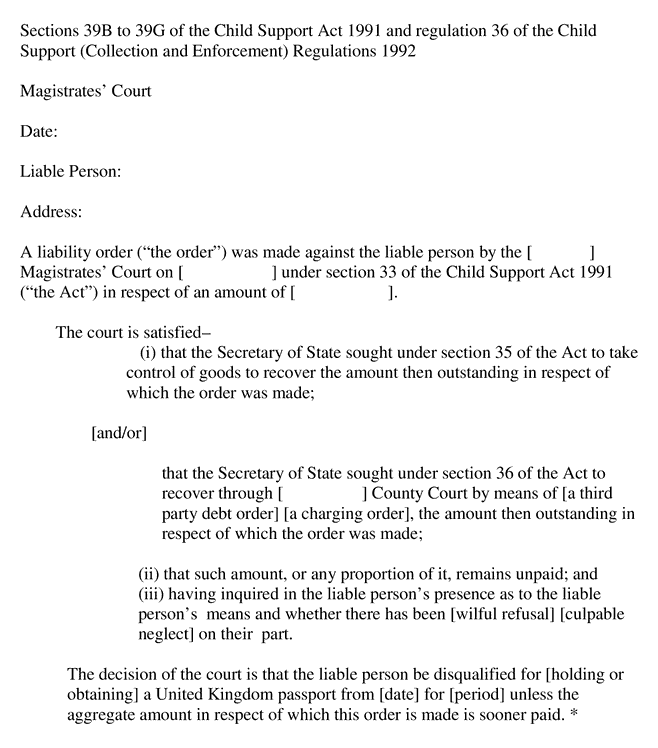
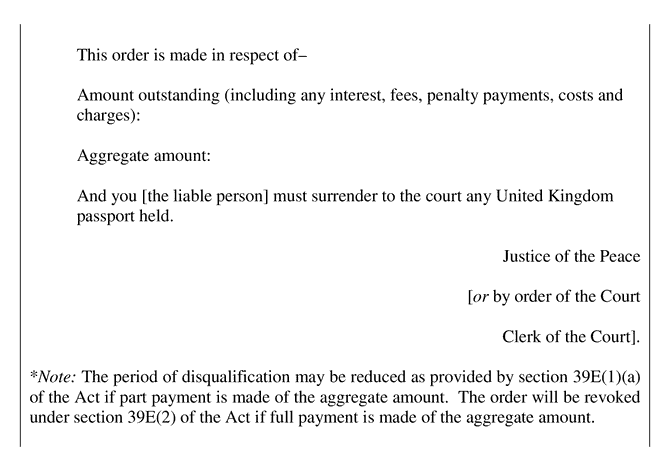
(4)
A disqualification order must be in the form prescribed in Schedule 5.
(5)
The amount to be included in the disqualification order under section 39B(8)(b) of the Act in respect of the costs of the application for the disqualification order must be such amount as in the view of the court is equal to the costs reasonably incurred by the Secretary of State in respect of the costs of the application for the disqualification order.
(6)
An order made under section 39B(9) of the Act may be executed anywhere in England and Wales by any person to whom it is directed or by any constable acting within the constable’s police area, if the liable person fails to appear or produce or surrender their United Kingdom passport to the court.
(7)
An order made under section 39B(9) of the Act may be executed by a constable even if it is not in the constable’s possession at the time but the order shall, if demanded, be shown to the liable person as soon as reasonably practicable.
(8)
The court shall send to the Secretary of State for the Home Department a United Kingdom passport produced to the court under section 39B(9) of the Act”.
(4)
After Schedule 4 insert, as Schedule 5, the Schedule set out in the Schedule to these Regulations.
Amendment of the Child Support Fees Regulations 20146.
(1)
(2)
“(aa)
section 39B(disqualification for holding or obtaining travel authorisation)22;(ab)
section 39G (application of sections 39B and 39F to Scotland);”
Signed by authority of the Secretary of State for Work and Pensions
SCHEDULESCHEDULE TO BE INSERTED AS SCHEDULE 5 TO THE CHILD SUPPORT (COLLECTION AND ENFORCEMENT) REGULATIONS 1992
“SCHEDULE 5
FORM OF ORDER OF DISQUALIFICATION FOR HOLDING OR OBTAINING A UNITED KINGDOM PASSPORT”
These Regulations amend child support regulations.
Regulation 2 inserts a new regulation 69A into the Child Support Maintenance (Calculation) Regulations 2012. The new regulation makes provision for specified assets to be calculated as having a weekly value which is taken into account in order to vary a maintenance calculation. The weekly value of the asset is treated as additional income of the non-resident parent. Virtual currencies which are capable of being traded for conventional currencies are assets for the purposes of the new regulation. Not all virtual currencies are capable of being traded in this way. Some are closed currencies which exist only within virtual communities, and have no link to real economies.
Regulation 3 makes amendments to the Child Support (Collection and Enforcement) Regulations 1992 and provides for the application of regular deduction orders and lump sum deduction orders to joint accounts. Such provision also extends the application of lump sum deduction orders to sole trader accounts and applies both orders to partnership accounts (where such a partnership is formed in England or Wales). In each of these cases, the person against whom one of these orders may be made will be an account-holder of the relevant account.
Regulation 4 makes amendments to the Child Support (Management of Payments and Arrears) Regulations 2009. It provides additional circumstances in which the Secretary of State may exercise the power to write off arrears in section 41E of the Child Support Act 1991.
Regulation 5 makes amendments to the Child Support (Collection and Enforcement) Regulations 1992. It makes provision in relation to disqualification for holding or obtaining a United Kingdom passport.
Regulation 6 makes amendments to the Child Support Fees Regulations 2014 (“the Fees Regulations”). It adds United Kingdom passport disqualification provisions to the exceptions listed in regulation 13(2) of the Fees Regulations which apply to the collection and enforcement of fees payable under the Fees Regulations.
An assessment of the impact of these Regulations on the costs of business and the voluntary sector is available from the Department for Work and Pensions, Caxton House, Tothill Street, London SW1H 9NA, and is annexed to the Explanatory Memorandum to these Regulations which is available alongside the instrument onwww.legislation.gov.uk