The Berkshire (Structural Change) Order 1996
And whereas the Secretary of State has decided to give effect to the recommendations, with modifications:
PART IGENERAL
Citation and commencement1.
This Order may be cited as the Berkshire (Structural Change) Order 1996 and shall come into force for the purposes of articles 2(2), 4(2) and (3), 6 and 9 to 15 on the day after the day on which it is made and for all other purposes on 1st April 1998.
Interpretation2.
(1)
In this Order—
“the Act” means the Local Government Act 1992;
“Berkshire” means the Royal County of Berkshire and “the County Council” means the council of that county;
“Berkshire district” means a district in Berkshire and “Berkshire district council” means a council of such a district;
“the relevant date” means 5th May 1997;
“relevant provision” means a provision in any subordinate legislation made under the Act or made, in connection with the Act or such provision, under any other enactment;
“the reorganisation date” means 1st April 1998; and
(2)
The period beginning with the relevant date and ending immediately before the reorganisation date is specified as the preliminary period for the purposes of any statutory instrument made under the Act.
PART IILOCAL GOVERNMENT REORGANISATION IN BERKSHIRE
Structural change3.
The County Council shall be wound up and dissolved and the functions of that council in relation to each Berkshire district shall, subject to the following provisions of this Part and to any other relevant provision, be transferred to the council of that district.
Fire services4.
(1)
(2)
For the purposes of the making of a combination scheme with respect to Berkshire before the reorganisation date in accordance with section 10 of the 1947 Act (power to make schemes in advance of alterations to local government areas), section 5(2) of that Act shall have effect, in relation to Berkshire, as if—
(a)
in paragraphs (a) and (d) of that subsection, for “the constituent authorities”, wherever those words occur, there were substituted “the council of the county of Berkshire”; and
(b)
in paragraphs (e) and (f) of that subsection, for “any of the constituent authorities” there were substituted “the council of the county of Berkshire”.
(3)
Section 10 of the 1947 Act shall have effect, in relation to Berkshire, as if after the word “but” there were inserted the words “, except so far as it relates to the constitution of an authority as the fire authority for the combined area constituted by the scheme and the performance by that authority of any functions necessary for bringing the scheme into full operation on that date,”.
Planning functions5.
(1)
(2)
In relation to a Berkshire district council—
(a)
section 36(5) of the 1990 Act (which provides that a local plan shall not contain policies in respect of minerals or waste) shall not apply;
(b)
subsection (1) of section 37 of that Act (minerals local plans) shall have effect as if, after the words “local plan”, there were added the words “or include in their local plan their detailed policies in respect of development consisting of the winning and working of minerals or involving the deposit of mineral waste”; and
(c)
“or
(c)
include their waste policies in their local plan.”.
Designated authority6.
(1)
The council of the borough of Reading is specified as the designated authority for the purposes of—
(a)
(b)
(2)
Superannuation fund7.
Berkshire Act 19868.
(1)
(2)
Section 14(3)(c)(ii) shall have effect as if for the words from “the highway authority” (where first occurring) to the end of the paragraph there were substituted the words “and the highway authority (if any) for the street in question, if the district council are not the highway authority”.
PART IIIELECTORAL ARRANGEMENTS
Electoral areas in Newbury and elections in Newbury in 1997 and subsequent years9.
(1)
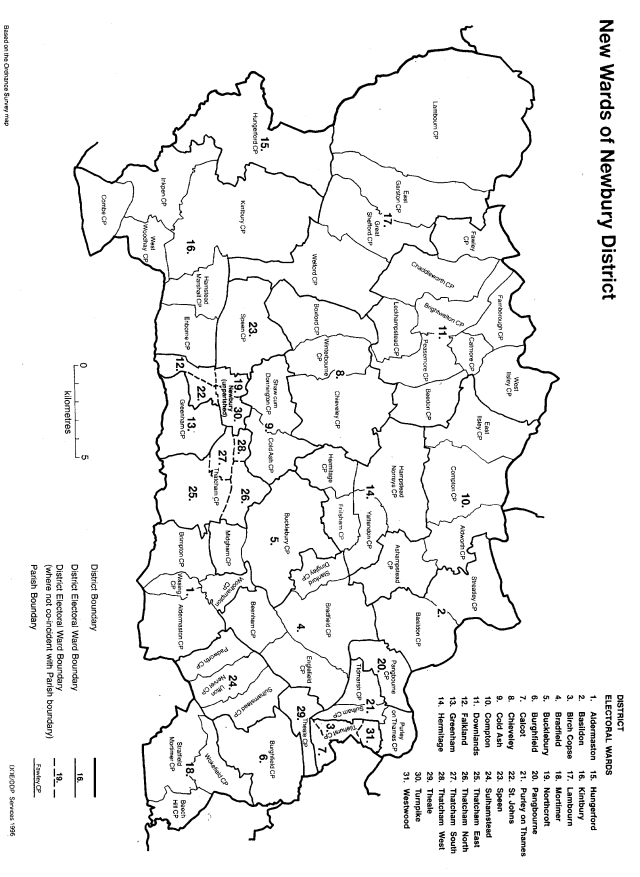
For the purposes of an election held on or after 1st May 1997, the existing wards of the district of Newbury (“Newbury”) shall be abolished and Newbury shall be divided into thirty-one wards which shall bear the names set out in column (1) of the Schedule to this Order.
(2)
The wards shall comprise the areas respectively described (in the manner described in paragraph (3) below) in column (2) of that Schedule, and the number of councillors to be elected for each ward shall be the number specified in respect of the ward in column (3) of that Schedule.
(3)
(4)
(5)
The term of office of any councillor so elected shall be, in the case of the councillors elected in 1997 and 2000, three years and, in any other case, four years.
(6)
On the fourth day after any such elections—
(a)
the persons who were councillors immediately before those elections shall retire; and
(b)
the newly elected councillors shall come into office.
(7)
Additional councillor in Slough10.
For the purposes of any election held on or after 1st May 1997 the number of councillors for the Colnbrook and Poyle ward in the borough of Slough shall be two.
PART IVTRANSITIONAL PROVISION
Elections in Bracknell Forest and Windsor and Maidenhead in 1997 and subsequent years11.
(1)
(2)
Elections of all councillors of the councils of the borough of Bracknell Forest and the Royal Borough of Windsor and Maidenhead shall be held simultaneously on the ordinary day of election of councillors in 1997, 2000, 2003 and every fourth year after 2003.
(3)
The term of office of any councillor so elected shall be, in the case of the councillors elected in 1997 and 2000, three years and, in any other case, four years.
(4)
On the fourth day after any such elections—
(a)
the persons who were councillors immediately before those elections shall retire; and
(b)
the newly-elected councillors shall come into office.
Elections in Reading in 1997 and subsequent years12.
“9.
(1)
Elections of all councillors for wards of the borough shall be held simultaneously on the ordinary day of election of councillors in 1997.
(2)
The councillors holding office for any ward of the borough immediately before 5th May 1997 shall retire on that date and the newly elected councillors for any such ward shall come into office on that date.
(3)
Of the councillors elected at the ordinary election of councillors in 1997 for any ward of the borough—
(a)
one-third shall retire in 1999 being, subject to paragraphs (4) and (5) below, the councillor elected by the smallest number of votes;
(b)
one-third shall retire in 2000 being, subject as aforesaid, the councillor elected by the next smallest number of votes;
(c)
the remaining councillor shall retire in 2001.
(4)
In the case of an equality of votes between any persons elected which makes it uncertain which of them is to retire in any such year, the person to retire in that year shall be determined by lot.
(5)
If an election of councillors for any ward is not contested, the person to retire in each such year shall be determined by lot.
(6)
Where under this article any question is to be determined by lot, the lot shall be drawn at the next practicable meeting of the council after the question has arisen, and the drawing shall be conducted under the direction of the person presiding at the meeting.
(7)
In each year in which a councillor for a ward in the borough retires in accordance with paragraphs (3) to (6) above an election of a councillor for that ward shall be held on the ordinary day of election of councillors in that year; and the term of office of councillors elected at such an election shall be three years.
(8)
Except as otherwise provided in the foregoing paragraphs of this article, the term of office of councillors shall be four years, and all councillors shall retire on the fourth day after the ordinary day of election of councillors for the borough in the year of retirement and the newly elected councillors shall come into office on the day on which their predecessors retire.”.
Elections in Slough in 1997 and subsequent years13.
“9.
(1)
Elections of all councillors of the borough shall be held simultaneously on the ordinary day of election of councillors in 1997.
(2)
The councillors holding office for any ward of the borough immediately before 5th May 1997 shall retire on that date and the newly elected councillors for any such ward shall come into office on that date.
(3)
Of the councillors elected at the ordinary election of councillors in 1997 for any ward of the borough, other than Colnbrook and Poyle—
(a)
one-third shall retire in 1999 being, subject to paragraphs (5) and (6) below, the councillor elected by the smallest number of votes;
(b)
one-third shall retire in 2000 being, subject as aforesaid, the councillor elected by the next smallest number of votes;
(c)
the remaining councillor shall retire in 2001.
(4)
Of the councillors elected at the ordinary election of councillors in 1997 for Colnbrook and Poyle ward—
(a)
one shall retire in 2000 being, subject to paragraphs (5) and (6) below, the councillor elected by the smaller number of votes,
(b)
the remaining councillor shall retire in 2001.
(5)
In the case of an equality of votes between any persons elected which makes it uncertain which of them is to retire in any such year, the person to retire in that year shall be determined by lot.
(6)
If an election of councillors for any ward is not contested, the person to retire in each such year shall be determined by lot.
(7)
Where under this article any question is to be determined by lot, the lot shall be drawn at the next practicable meeting of the council after the question has arisen, and the drawing shall be conducted under the direction of the person presiding at the meeting.
(8)
In each year in which a councillor for a ward in the borough retires in accordance with paragraphs (3) to (7) above an election of a councillor for that ward shall be held on the ordinary day of election of councillors in that year; and the term of office of councillors elected at such an election shall be three years.
(9)
Except as otherwise provided in the foregoing paragraphs of this article, the term of office of councillors shall be four years, and all councillors shall retire on the fourth day after the ordinary day of election of councillors for the borough in the year of retirement and the newly elected councillors shall come into office on the day on which their predecessors retire.”.
Elections in Wokingham in 1997 and subsequent years14.
(1)
(2)
“6.
(1)
Elections of all councillors for wards of the district shall be held simultaneously on the ordinary day of election of councillors in 1997.
(2)
The councillors holding office for any ward in the district immediately before 5th May 1997 shall retire on that date and the newly elected councillors for any such ward shall come into office on that date.
(3)
The order of retirement of the councillors elected in 1997 shall be as set out in Schedule 2 to this Order.
(4)
Where the number of councillors elected at the ordinary election of councillors in 1997 for any ward of the district is two, the first to retire in that ward shall be, subject to paragraphs (6) and (7) below, the councillor elected by the smaller number of votes.
(5)
Where the number of councillors elected at the ordinary election of councillors in 1997 for any ward of the district is three—
(a)
one-third shall retire in 1999 being, subject to paragraphs (6) and (7) below, the councillor elected by the smallest number of votes;
(b)
one-third shall retire in 2000 being, subject as aforesaid, the councillor elected by the next smallest number of votes;
(c)
the remaining councillor shall retire in 2001.
(6)
In the case of an equality of votes between any persons elected which makes it uncertain which of them is to retire in any such year, the person to retire in that year shall be determined by lot.
(7)
If an election of councillors for any ward is not contested, the person to retire in each such year shall be determined by lot.
(8)
Where under this article any question is to be determined by lot, the lot shall be drawn at the next practicable meeting of the council after the question has arisen, and the drawing shall be conducted under the direction of the person presiding at the meeting.
(9)
In each year in which a councillor for a ward in the district retires in accordance with paragraphs (3) to (8) above an election of a councillor for that ward shall be held on the ordinary day of election of councillors in that year; and the term of office of councillors elected at such an election shall be three years.
(10)
Except as otherwise provided in the foregoing paragraphs of this article, the term of office of councillors shall be four years, and all councillors shall retire on the fourth day after the ordinary day of election of councillors for the district in the year of retirement and the newly elected councillors shall come into office on the day on which their predecessors retire.”.
(3)
“SCHEDULE 2ORDER OF RETIREMENT OF COUNCILLORS
Name of ward
Number of councillors to retire in 1999
Number of councillors to retire in 2000
Number of councillors to retire in 2001
Arborfield
1
0
0
Barkham
0
1
0
Bulmershe
1
0
1
Charvil
0
0
1
Coronation
1
1
1
Emmbrook
1
1
1
Evendons
1
1
1
Finchampstead North
1
0
1
Finchampstead South
1
1
0
Hurst
0
0
1
Little Hungerford
1
1
1
Loddon
1
1
1
Norreys
1
1
1
Redhatch
1
1
1
Remenham and Wargrave
1
1
0
Shinfield
1
1
1
Sonning
0
1
0
South Lake
1
1
1
Swallowfield
1
0
0
Twyford and Ruscombe
1
1
1
Westcott
0
1
1
Whitegates
0
1
1
Winnersh
1
1
1
Wokingham Without
1
1
1”.
Suspension of elections and casual vacancies15.
(1)
The ordinary election of councillors in 1997 for the County Council shall not take place; and any councillor for that council holding office immediately before the relevant date who would, but for this paragraph, have retired on that date shall, unless he resigns his office or it otherwise becomes vacant, continue to hold office until the reorganisation date.
(2)
Section 89 of the 1972 Act (filling of casual vacancies in case of councillors) shall have effect—
(a)
in the case of a casual vacancy occurring in the office of councillor of a Berkshire district before the relevant date, as if the reference in subsection (3) of that section to the day on which the councillor whose office is vacant would regularly have retired were a reference to the relevant date; and
(b)
in the case of a casual vacancy occurring in the office of councillor for any electoral division in Berkshire, as if that reference in that subsection were a reference to the reorganisation date.
Signed by authority of the Secretary of State
SCHEDULEWARDS OF DISTRICT OF NEWBURY: NAMES, AREAS AND NUMBERS OF COUNCILLORS
(1) | (2) | (3) |
|---|---|---|
Name of ward | Description of area of ward | Number of councillors |
Aldermaston | The parishes of Aldermaston, Brimpton, Wasing and Woolhampton | 1 |
Basildon | The parishes of Basildon and Streatley | 1 |
Birch Copse | The parish ward of Tilehurst Birch Copse (see Maps 3 and 4) | 2 |
Bradfield | The parishes of Beenham, Bradfield, Englefield and Stanford Dingley | 1 |
Bucklebury | The parishes of Bucklebury and Midgham | 1 |
Burghfield | The parish of Burghfield | 2 |
Calcot | The parish ward of Tilehurst Calcot (see Maps 3 and 4) | 1 |
Chievely | The parishes of Boxford, Chieveley and Winterbourne | 1 |
Cold Ash | The parishes of Cold Ash and Shaw-cum-Donnington | 2 |
Compton | The parishes of Aldworth, Ashampstead, Compton and East Ilsley | 1 |
Downlands | The parishes of Beedon, Brightwalton, Catmore, Chaddleworth, Farnborough, Fawley, Leckhampstead, Peasemore and West Ilsley | 1 |
Falkland | The area is shown on Map 1 | 3 |
Greenham | The parish of Greenham | 1 |
Hermitage | The parishes of Frilsham, Hampstead Norreys, Hermitage and Yattendon | 1 |
Hungerford | The parish of Hungerford | 2 |
Kintbury | The parishes of Combe, Enborne, Hamstead Marshall, Inkpen, Kintbury and West Woodhay | 2 |
Lambourn | The parishes of East Garston, Great Shefford, Lambourn and Welford | 2 |
Mortimer | The parishes of Beech Hill, Stratfield Mortimer and Wokefield | 2 |
Northcroft | The area is shown on Map 1 | 3 |
Pangbourne | The parish of Pangbourne | 1 |
Purley on Thames | The parishes of Purley on Thames, Sulham and Tidmarsh | 2 |
St. Johns | The area is shown on Map 1 | 3 |
Speen | The parish of Speen | 1 |
Sulhamstead | The parishes of Padworth, Sulhamstead and Ufton Nervet | 1 |
Thatcham East | The area is shown on Map 2 | 2 |
Thatcham North | The area is shown on Map 2 | 3 |
Thatcham South | The area is shown on Maps 1 and 2 | 2 |
Thatcham West | The area is shown on Maps 1 and 2 | 1 |
Theale | The parish of Theale | 3 |
Turnpike | The area is shown on Map 1 | 3 |
Westwood | The parish ward of Tilehurst Westwood (see Map 3) | 2 |
This Order gives effect to recommendations by the Local Government Commission for England for the making of structural and electoral changes in the Royal County of Berkshire.
Article 3 effects the structural change by providing for the abolition of the county council of Berkshire on 1st April 1998 and the transfer of its functions, in relation to each district in the county, to the council of the district.
Article 4 makes provision for the purposes of subordinate legislation which may be made under the Fire Services Act 1947 in respect of fire services.
Article 5 makes provision in relation to the Berkshire structure plan and to enable the local plans prepared by the district councils under the Town and Country Planning Act 1990 to contain minerals and waste policies.
Article 6 designates the council of the borough of Reading for the purposes of regulations relating to finance and the transfer of property, rights and liabilities, and the council of the district of Newbury for the purposes of regulations relating to certain employment liabilities.
Article 7 vests the county council’s superannuation fund in the council of the Royal Borough of Windsor and Maidenhead.
Article 8 makes provision in relation to the Berkshire Act 1986.
Article 9 and the Schedule make provision for electoral arrangements in Newbury, including provision for whole council elections in 1997, 2000 and 2003 and every fourth year after 2003. The new wards are shown on the 4 maps prepared by the Department of the Environment, marked “Maps of the Berkshire (Structural Change) Order 1996”. The map forming part of this Note indicates the areas of the new wards.
Article 10 provides for there to be an additional councillor for the Colnbrook and Poyle ward in the borough of Slough.
Article 11 makes provision for whole council elections in Bracknell Forest and Windsor and Maidenhead in 1997, 2000 and 2003 and every fourth year after 2003.
Articles 12, 13 and 14 make provision for elections in Reading, Slough and Wokingham, respectively, in 1997 and subsequent years.
Article 15 provides for the suspension of county council elections in 1997 and extends the term of office of county councillors until 1st April 1998. It also makes provision in respect of casual vacancies in the office of councillor of the local authorities affected by this Order.